So I had some people I know going to Japan during the sakura bloom, and I managed to get my hands on some sakura snacks. I thought I had better post on them while it's still sakura season in some parts of Japan... I think it's at Aomori now, according to this official calendar, and it'll be in Hokkaido next week. I'll only comment on two, which I actually got to try. The others were just pictures I received from those who went.
Sakura Mochi
First up is authentic sakura mochi. Note that this is very different from other types of mochi where the glutinous rice is pounded until it forms a sticky paste. From what I can gather, this one is just pink mochi rice, wrapped in a pickled sakura leaf, and filled with the standard Japanese red bean paste. As the rice is still coarse, this would be the traditional Kansai-style sakura mochi, and the variety of rice is glutinous rice. Because of the herby leaf wrapping the sticky rice, it reminds me a lot of the Peranakan glutinous rice sweets and dumplings.

 They came in a small container of two... each ball was really small - about 1.5 inches (or maybe slightly larger) in diameter. You can easily pop an entire mochi ball into your mouth, as I think you're meant to, otherwise it will be messy with the leaf getting in the way.
I couldn't quite taste any sakura in the rice itself, but the leaf tasted like the authentic picked Japanese sakura leaf, which is kind of salty, slightly sour (as they use sour plum) and with a herb-like grassy taste to it. And that went very well with the sweet azuki red bean paste, the way herby flavours tend to go well with sweet stuff, like lemongrass drink or lavender ice cream.


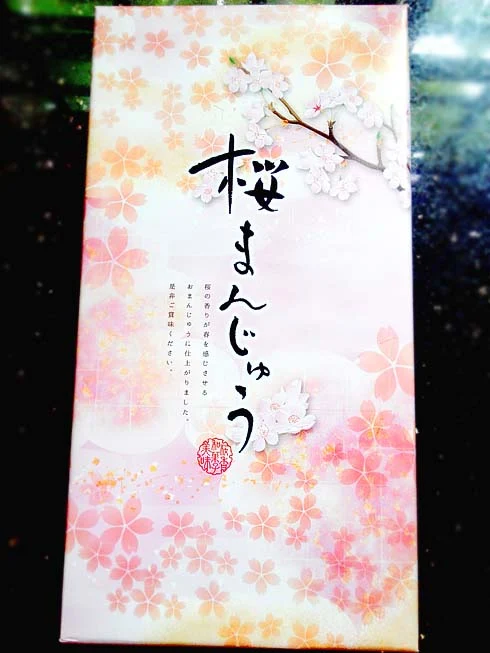
 Once again, it appears that the main sakura ingredient is pickled sakura leaves, which was mixed into the bun part of the manju. You can see the brownish-green spots in the otherwise pink manju. From what I've seen, people hardly use the flowers.
Its filling was pure and traditional Japanese azuki paste, with no sakura inside that I noticed.
 The sakura manju skin (or bun part) had a fresher and more fragrant leafy taste than the sakura mochi. However, unlike the mochi, the azuki paste dominated the overall taste, which was mostly sweet, with at most a mild bean flavour. So the sakura leaves' flavour had more of an embellishing effect.
You can also chew the sakura leaves in nice small chewy bits, which was a pleasant extra effect to the otherwise completely soft texture. This is in contrast to the sheet of sakura leaf for the mochi.
Sakura Soba
This was probably the most interesting item that I would have liked to try... unfortunately, it was something that my companion had on the plane, and so she obviously couldn't save it for me. (Can you believe it, such interesting seasonal fare on an airline? I believe it was Singapore Airlines... maybe that would explain it.)
She said that she could taste the sakura flavour distinctly. It would have been interesting to experience how that taste would go with the onions, wasabi and soba sauce that came with it...
 Sakura Crepe
Finally, this is Korot Crepe with sakura paste (which is hard to see in the picture... but it's a paste like the azuki paste), matcha warabi mochi and normal cream that's just coloured pink. Interesting combination that I haven't tried before. My friend raved about how delicious it was. Oh well, maybe next time...


Sakura Mochi
First up is authentic sakura mochi. Note that this is very different from other types of mochi where the glutinous rice is pounded until it forms a sticky paste. From what I can gather, this one is just pink mochi rice, wrapped in a pickled sakura leaf, and filled with the standard Japanese red bean paste. As the rice is still coarse, this would be the traditional Kansai-style sakura mochi, and the variety of rice is glutinous rice. Because of the herby leaf wrapping the sticky rice, it reminds me a lot of the Peranakan glutinous rice sweets and dumplings.


I couldn't quite taste any sakura in the rice itself, but the leaf tasted like the authentic picked Japanese sakura leaf, which is kind of salty, slightly sour (as they use sour plum) and with a herb-like grassy taste to it. And that went very well with the sweet azuki red bean paste, the way herby flavours tend to go well with sweet stuff, like lemongrass drink or lavender ice cream.

Texture-wise, it was very soft and sticky... the ingredients list contained kanten, or agar agar as we know it in Southeast Asia. It's a kind of jelly, which I suppose was added to help with either the texture of the leaf during the pickling process or possibly the azuki paste. At least, I've seen it in the ingredients list for the adzuki paste before. (It wouldn't make sense that they would want to add it to the rice to "firm" it up.)
The leaf provided a nice fibrous and chewy complement. It wasn't hard to chew, because it was very soft probably from all the pickling or cooking. But it did help to provide a substantial contrast to the otherwise plainly soft and gooey experience.
I guess I would classify this as comfort food. The kind of dessert that you would like as a kid, and then persist in eating into adulthood out of nostalgia.
Sakura Manju
Next up, is something more like a bun - sakura manjuu, or manju if you go by the common internet transliteration of Japanese. It appears to be a Japanese derivative of the Chinese steamed buns, which we call pao or pau if it contains filling, or mantou (the Chinese transliteration of manju) if there's no filling. However, unlike Chinese steamed buns which are normally served fresh, this one was shelf-stable and came in plastic wrappers like in the photo below.


Its filling was pure and traditional Japanese azuki paste, with no sakura inside that I noticed.

You can also chew the sakura leaves in nice small chewy bits, which was a pleasant extra effect to the otherwise completely soft texture. This is in contrast to the sheet of sakura leaf for the mochi.
Sakura Soba
This was probably the most interesting item that I would have liked to try... unfortunately, it was something that my companion had on the plane, and so she obviously couldn't save it for me. (Can you believe it, such interesting seasonal fare on an airline? I believe it was Singapore Airlines... maybe that would explain it.)
She said that she could taste the sakura flavour distinctly. It would have been interesting to experience how that taste would go with the onions, wasabi and soba sauce that came with it...

Finally, this is Korot Crepe with sakura paste (which is hard to see in the picture... but it's a paste like the azuki paste), matcha warabi mochi and normal cream that's just coloured pink. Interesting combination that I haven't tried before. My friend raved about how delicious it was. Oh well, maybe next time...

And here's their promo image from their site, with the description, for reference. In the promo image, the sakura paste can be clearly seen as the darker pink patch. It's a seasonal offering, available only during the spring.

I also still have some sakura tea that I haven't brewed and tried... but it has a later expiry date, so maybe I'll feature it in an out-of-season post much later.
Comments
Post a Comment